
By invitation only · Learning and networking · No sales, ever
fsyncDATA Circle: an invitation-only club for India’s GCC data leaders
Founding session November 2026 | Bengaluru · Hyderabad · Pune · Chennai · Online
A private room for the GCC data leaders who run India’s Global Capability Center data estates: site leaders, chief data officers, chief data and analytics officers, chief AI officers, chief data scientists, CIOs, CTOs and principal database architects. A room where the numbers stay in, the vendors stay out, and the decisions get better.
0
sales conversations permitted inside the Circle, including by its convener
60
founding seats across the leadership roles and four cities, then closed
90 min
a month, engineered to return more than a conference week
₹0
membership fee. The price of a seat is one contribution a year
Why GCC data leaders need a room of their own
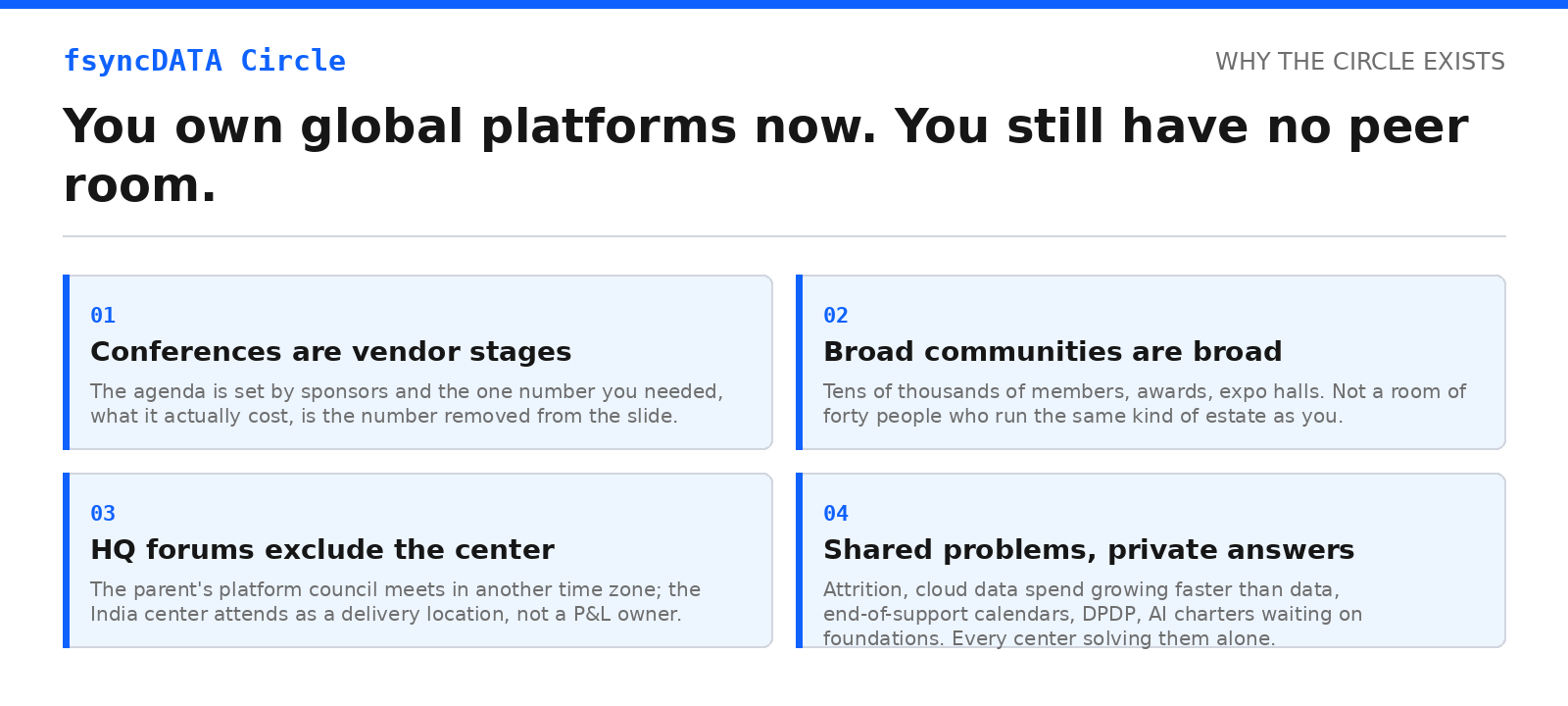
India’s capability centers have moved from tickets to portfolio ownership. Platform reliability, data engineering, cloud architecture and AI pipelines for some of the world’s largest enterprises are now decided in Bengaluru, Hyderabad, Pune and Chennai. The GCC data leaders making those decisions have everything except each other.
What the Circle gives GCC data leaders instead of another conference:
- A room of forty people who run the same kind of estate as you, not a stage set by sponsors
- The one number every talk removes from the slide: what it actually cost
- A seat as the owner of a P&L and a platform, not as a delivery location
- Answers to the problems every center is solving alone: attrition, cloud data spend, end-of-support, DPDP, AI foundations
- A phone number you can call at 3 a.m.
The premise. Decisions of this size deserve witnesses. A leader who has already run the migration you are about to run, seen the invoice you are about to receive, or survived the audit you are preparing for, is worth more than any report. The Circle exists to put that person across the table from you, under rules that let them tell the truth.
Who sits at the table
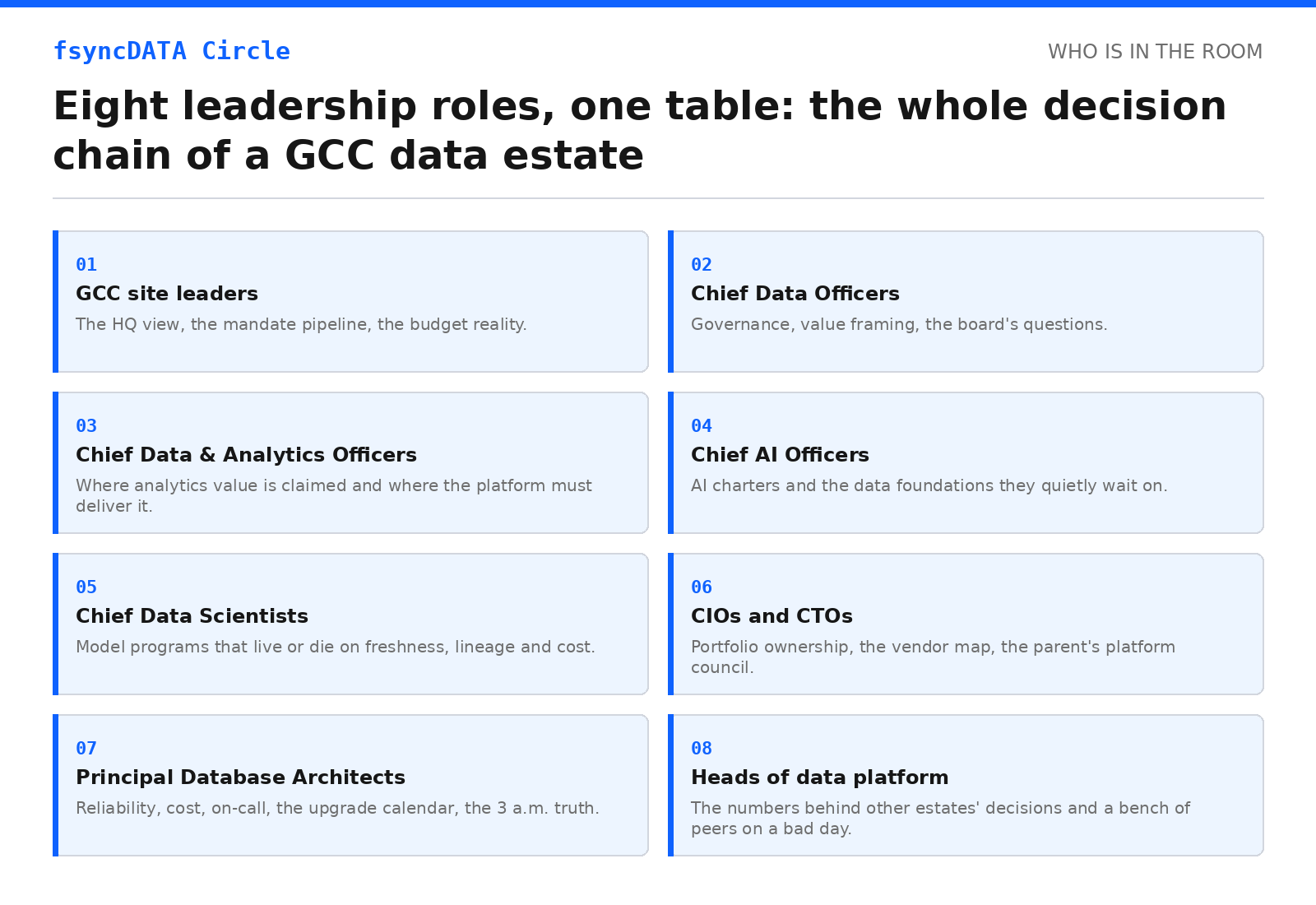
Most rooms for GCC data leaders seat one role. Platform heads meet platform heads and agree the CDO does not understand cost; CDOs meet CDOs and agree the platform team is slow. The Circle seats the whole decision chain of a capability center’s data estate, so the conversation you have here is the one you cannot have at work.
| Cohort | What they bring | What they come for |
|---|---|---|
| GCC site leaders | The HQ view, the mandate pipeline, the budget reality | How other centers won platform ownership and kept it |
| Chief Data Officers and Chief Data & Analytics Officers | Governance, value framing, the board’s questions | What the platform actually needs before AI and analytics charters can be honoured |
| Chief AI Officers and Chief Data Scientists | AI charters, model programs, the freshness and lineage they depend on | The foundations work that precedes every model initiative, and what it really took elsewhere |
| CIOs and CTOs | Portfolio ownership, the vendor map, the parent’s platform council | How centers earn a seat at the parent’s table and what to bring to it |
| Principal Database Architects and heads of data platform | Reliability, cost, on-call, the upgrade calendar, what production does at 3 a.m. | The numbers behind other estates’ decisions, and a bench of peers on a bad day |
The sector mix of GCC data leaders is deliberate: BFSI captives with regulated change and commercial engines; retail and CPG with peak seasons and real-time analytics; software and product centers with cloud-native estates and a DBRE culture; healthcare and pharma with validated environments; industrial and engineering centers with SAP-centric estates and telemetry; PE-backed mid-market centers with fast decisions and tight budgets.
The stage mix is deliberate too. Day-1 centers under eighteen months old are building the platform for the first time. Scaling centers between eighteen and forty-eight months are taking production ownership from HQ and from outsourced towers. Portfolio owners past four years run global platforms, budgets and P&L from India. A Day-1 center learns what a portfolio owner wishes it had done in year one; a portfolio owner learns what the newest centers are being asked to build. Both are why the room is mixed.
See who is in the room
Eight leadership roles, six sectors, three center stages, one table.
Read the six rules
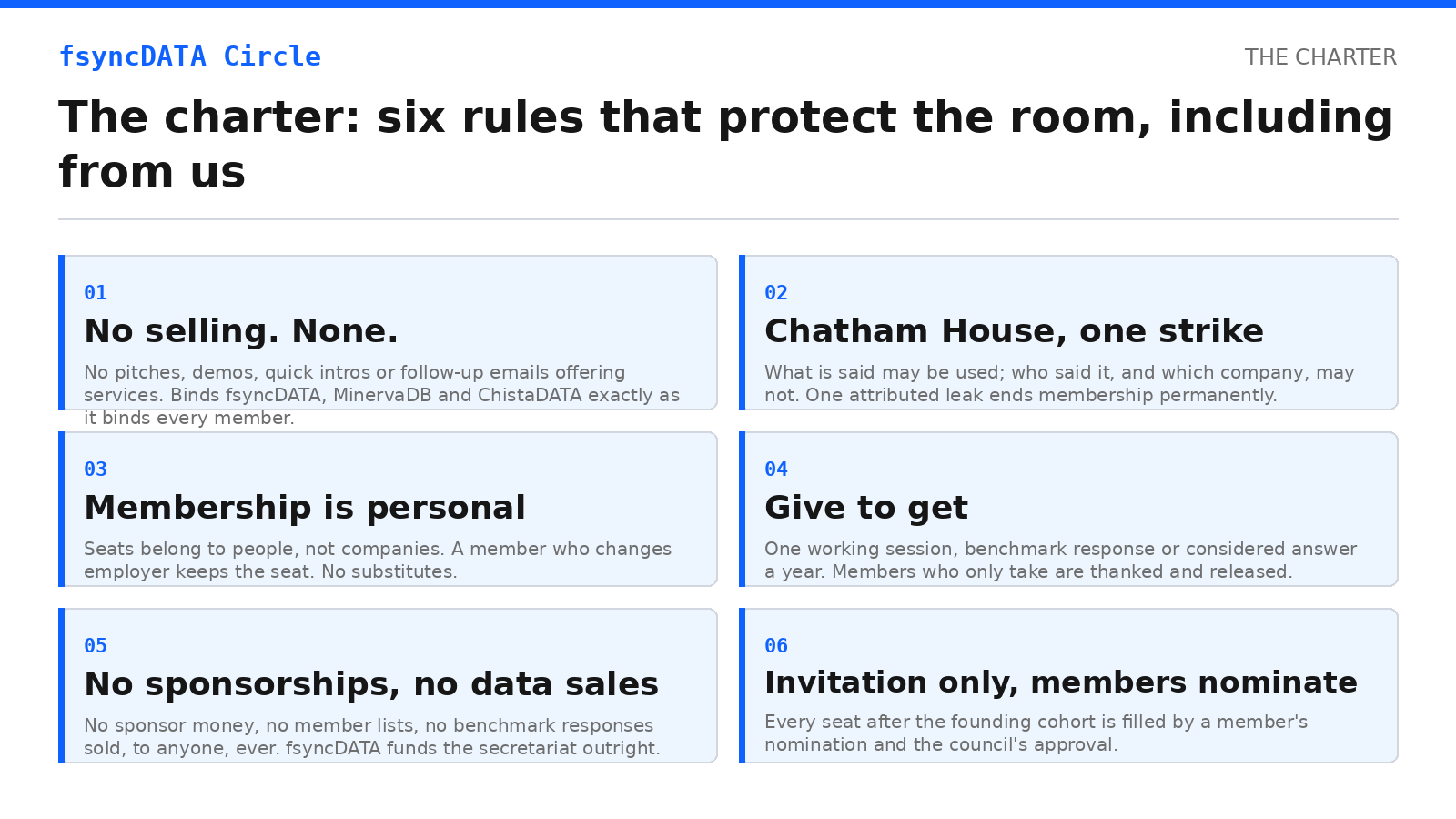
No selling. Chatham House, one strike. Personal seats. Give to get. No sponsors. Nominate only.
See what you learn
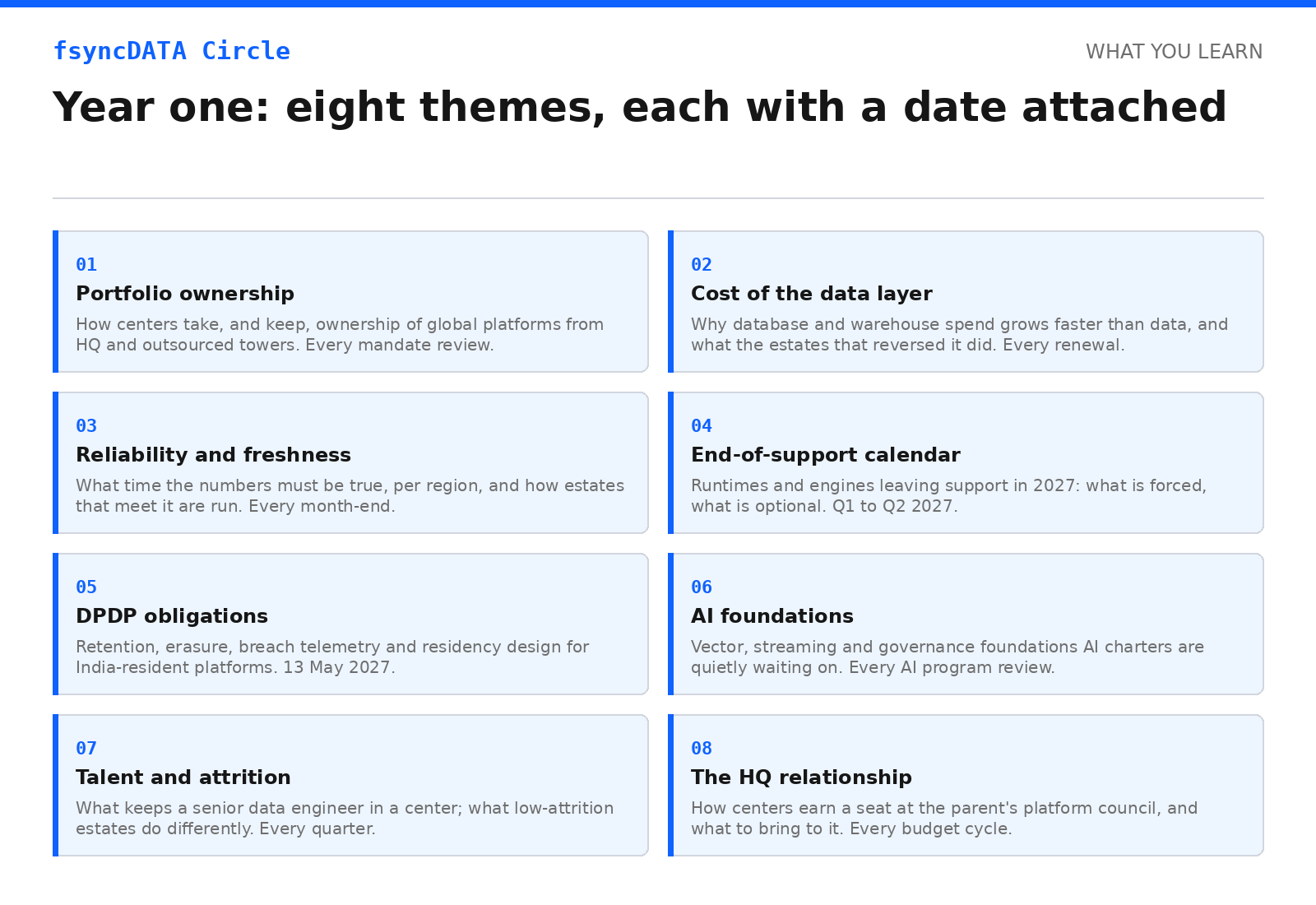
Eight decisions with dates attached, six working formats, about thirty hours a year.
The charter that protects GCC data leaders
A club is only as useful as the things GCC data leaders are willing to say in it. The charter exists so that a head of data platform can say what a migration really cost, and a site leader can say what HQ really thinks, without either sentence ever being used against them. Six rules written for GCC data leaders, and they bind fsyncDATA, MinervaDB and ChistaDATA exactly as they bind every member.
- No selling. None. No pitches, no product demonstrations, no quick intro to what we do, no follow-up emails offering services to people met in the Circle.
- Chatham House, one strike. What is said may be used; who said it, and which company, may not. One attributed leak, however small, ends membership permanently.
- Membership is personal. Seats belong to people, not companies. A member who changes employer keeps the seat. A company cannot send a substitute.
- Give to get. Each year every member contributes at least one working session, benchmark response, or considered answer to a peer’s question.
- No sponsorships, no data sales. The Circle takes no sponsorship money and sells no member data, lists or benchmark responses, to anyone, ever.
- Invitation only, members nominate. Every seat after the founding cohort is filled by a member’s nomination and the council’s approval.
Enforcement belongs to the members’ council, not to fsyncDATA. Five elected members, rotating annually, hear any complaint and their decision is final. We have no veto and no seat on the council. If the council ever finds fsyncDATA in breach of Rule 1, the council may dissolve the Circle and take its member directory with it. The rules are written so that we can lose by them.
The charter follows the Chatham House Rule as published by Chatham House, with one difference: there is no warning stage. Full text on the Circle charter page.
What GCC data leaders learn in year one
The curriculum for GCC data leaders is not a syllabus. It is the set of decisions GCC data leaders will face in the next eighteen months, worked through with people who face them too. Each theme runs as a working session with the numbers left in, and each has a date attached.
| Theme | The decision | The date |
|---|---|---|
| Portfolio ownership | How centers take, and keep, ownership of global platforms from HQ and from outsourced towers | Every mandate review |
| Cost of the data layer | Why database and warehouse spend grows faster than data, and what the estates that reversed it did | Every renewal and commit |
| Reliability and freshness | What time the numbers must be true, per region, and how estates that meet it are run | Every month-end |
| End-of-support calendar | Runtimes and engines leaving support in 2027: what is actually forced, what is optional | Q1 to Q2 2027 |
| DPDP obligations | Retention, erasure, breach telemetry and residency design for India-resident platforms | 13 May 2027 |
| AI foundations | Vector, streaming and governance foundations that AI charters are quietly waiting on | Every AI program review |
| Talent and attrition | What keeps a senior data engineer in a center; what the estates with low attrition do differently | Every quarter |
| The HQ relationship | How centers earn a seat at the parent’s platform council, and what to bring to it | Every budget cycle |
How a session works for GCC data leaders: one of the GCC data leaders in the room brings a real decision, with its numbers. Twenty minutes of story, forty of questions from the room, thirty of what the room would do. No slides beyond the numbers. A one-page summary, anonymised, goes to the reading room the next day.
What you leave with is something you can act on Monday: a number to check in your own estate, a question to put to a vendor, a design you will not repeat, or a peer you can call when the same thing happens to you. The eight themes and the six formats are described on the GCC data platform curriculum page.
How the Circle works, month by month
Six working surfaces, one membership, all built around what GCC data leaders can actually attend. A monthly working session of ninety minutes, online, one decision, numbers in, attendance capped at forty so every voice is heard. A quarterly deep dive of half a day on one theme, in person in one city and online for the rest, with two member war stories, one open working session and dinner after.
Fortnightly office hours where fsyncDATA and MinervaDB principal engineers answer GCC data leaders’ technical questions for an hour; questions and answers stay in the Circle, and nothing is scoped, quoted or followed up. Ask the network: a member posts a question, the secretariat routes it to the three members best placed to answer, and answers arrive within 48 hours. The reading room, with session summaries, post-mortems and reference designs, members only and searchable. And the annual benchmark.
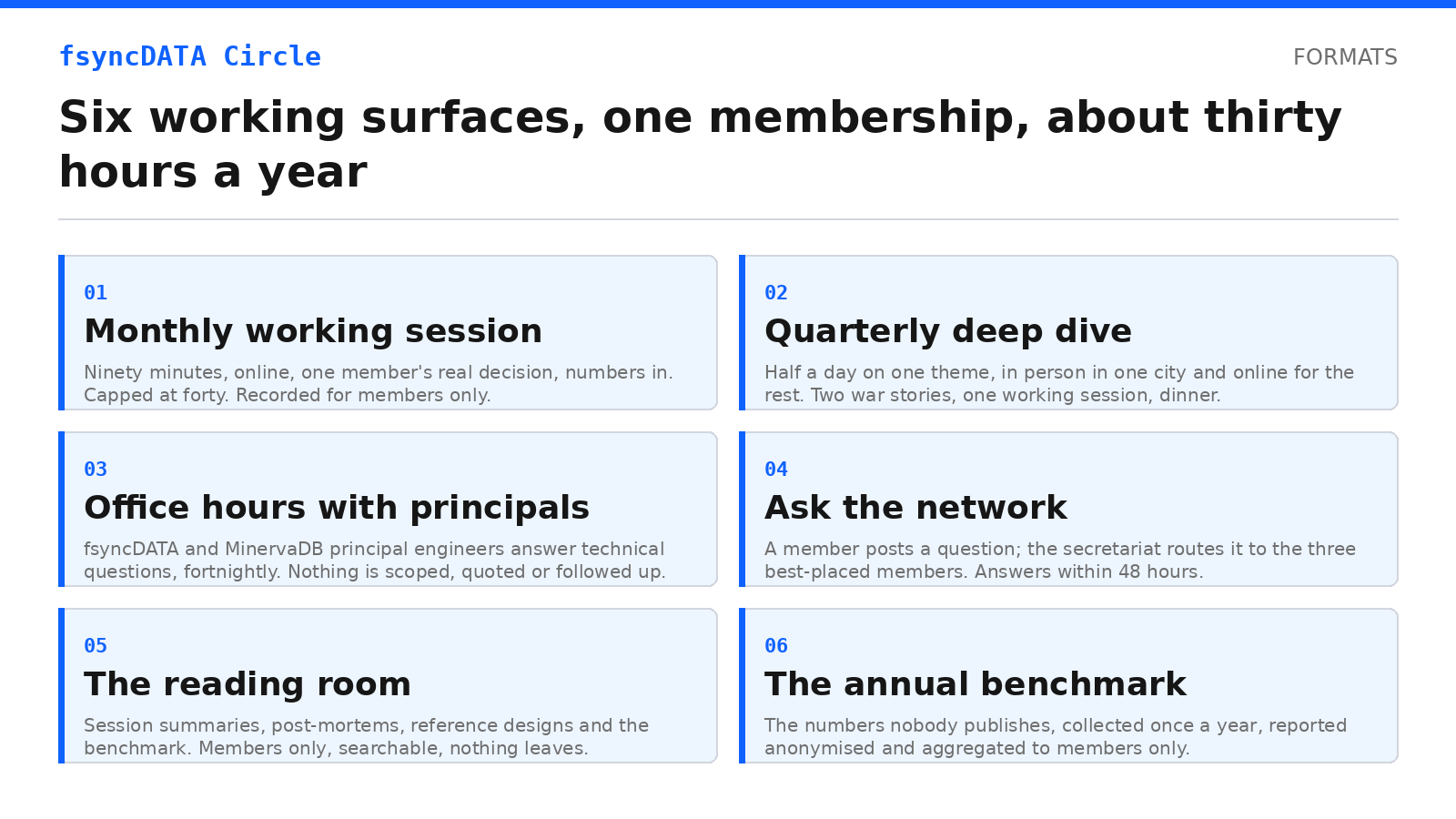
Six formats, one membership
Working sessions, deep dives, office hours, ask the network, the reading room, the benchmark.
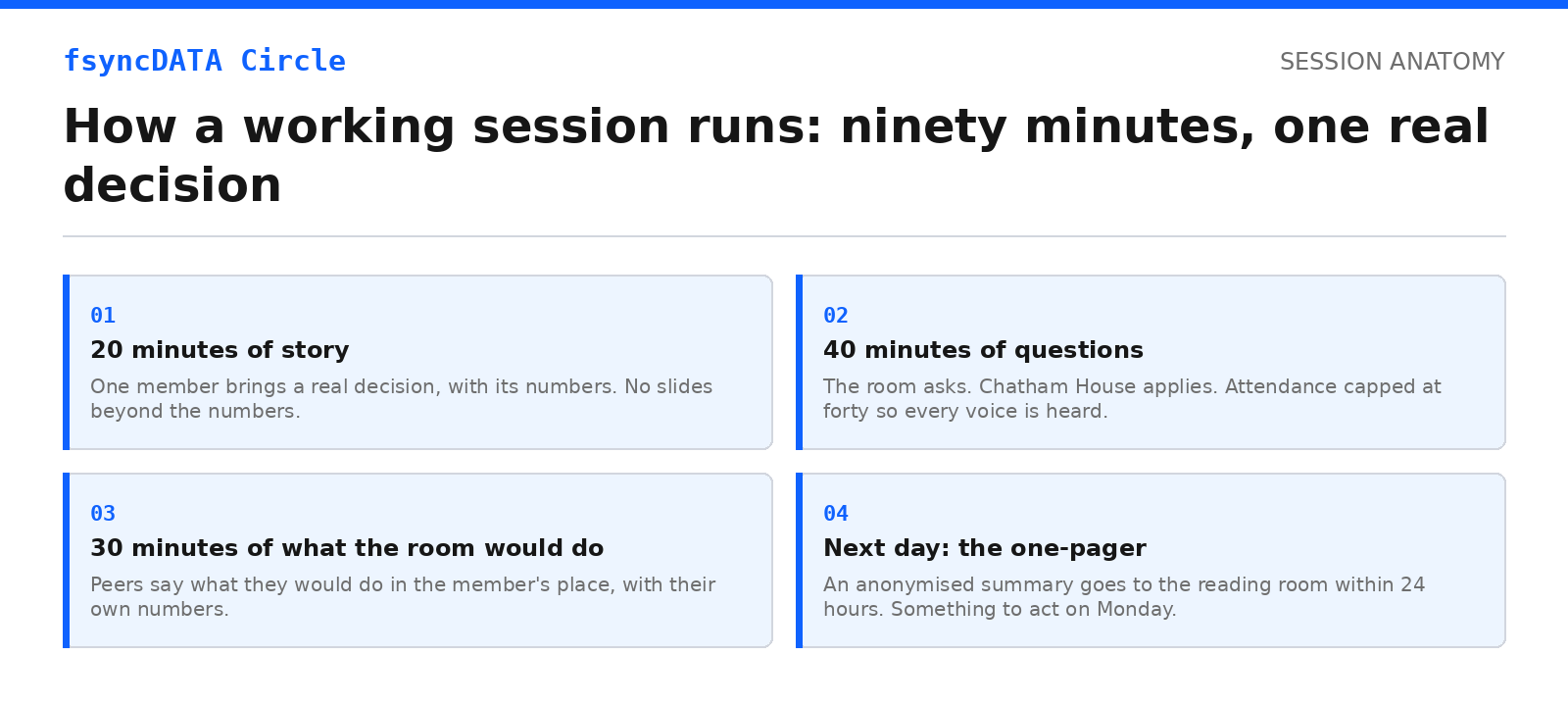
Ninety minutes, one real decision
Twenty minutes of story, forty of questions, thirty of what the room would do. No slides beyond the numbers.
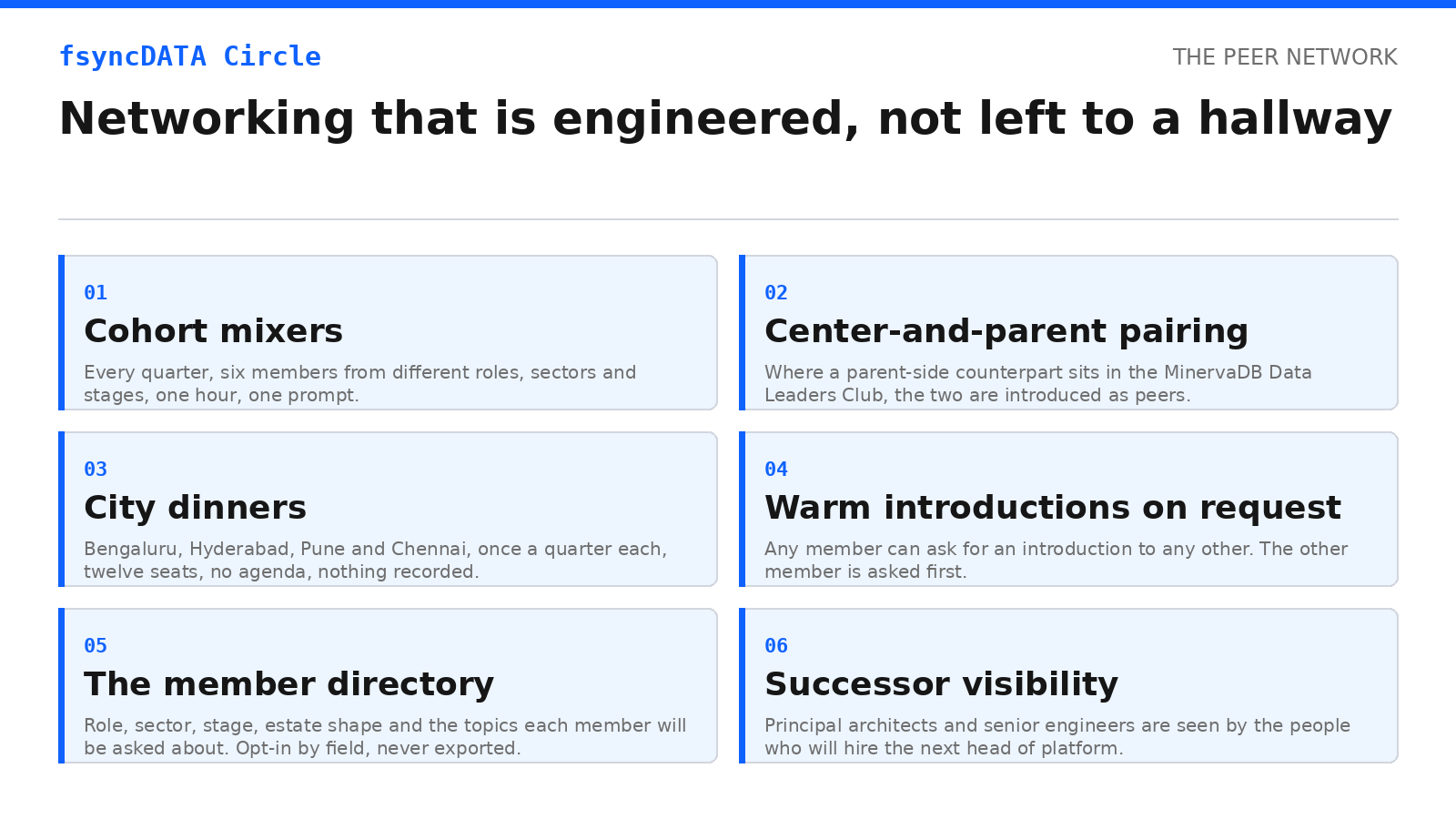
Networking, engineered
Cohort mixers, center-and-parent pairing, city dinners, warm introductions, the directory, successor visibility.
A year in the Circle: November 2026 to October 2027
Dates are set a year ahead so GCC data leaders can hold them. Less calendar than one conference trip: twelve monthly sessions, four deep dives and the office hours you choose add up to roughly thirty hours a year. GCC data leaders are busy; the Circle is designed to cost less time than the rooms it replaces. Full dates on the Circle calendar.
QUARTER 1
Nov 2026 – Jan 2027
NOV · Bengaluru
Founding session: charter adopted, council elected, portfolio ownership
DEC · Online
Cost of the data layer: one estate’s twelve-month invoice, line by line
JAN · Online
Reliability and freshness at month-end; benchmark survey opens
QUARTER 2
Feb – Apr 2027
FEB · Hyderabad
Deep dive: end-of-support 2027, what is forced and what is not
MAR · Online
DPDP readiness with sixty days to go
APR · Online
Benchmark readout: the first annual GCC Data Platform Benchmark
QUARTER 3
May – Jul 2027
MAY · Pune
Deep dive: AI foundations, the platform work three charters waited on
JUN · Online
Talent and attrition: what low-attrition centers do differently
JUL · Online
The HQ relationship: earning a seat at the parent’s platform council
QUARTER 4
Aug – Oct 2027
AUG · Chennai
Deep dive: architecture post-mortems, three designs three years on
SEP · Online
Members’ choice: the theme the room votes for in July
OCT · Bengaluru
Annual assembly: council election, charter review, second cohort
The benchmark nobody else publishes
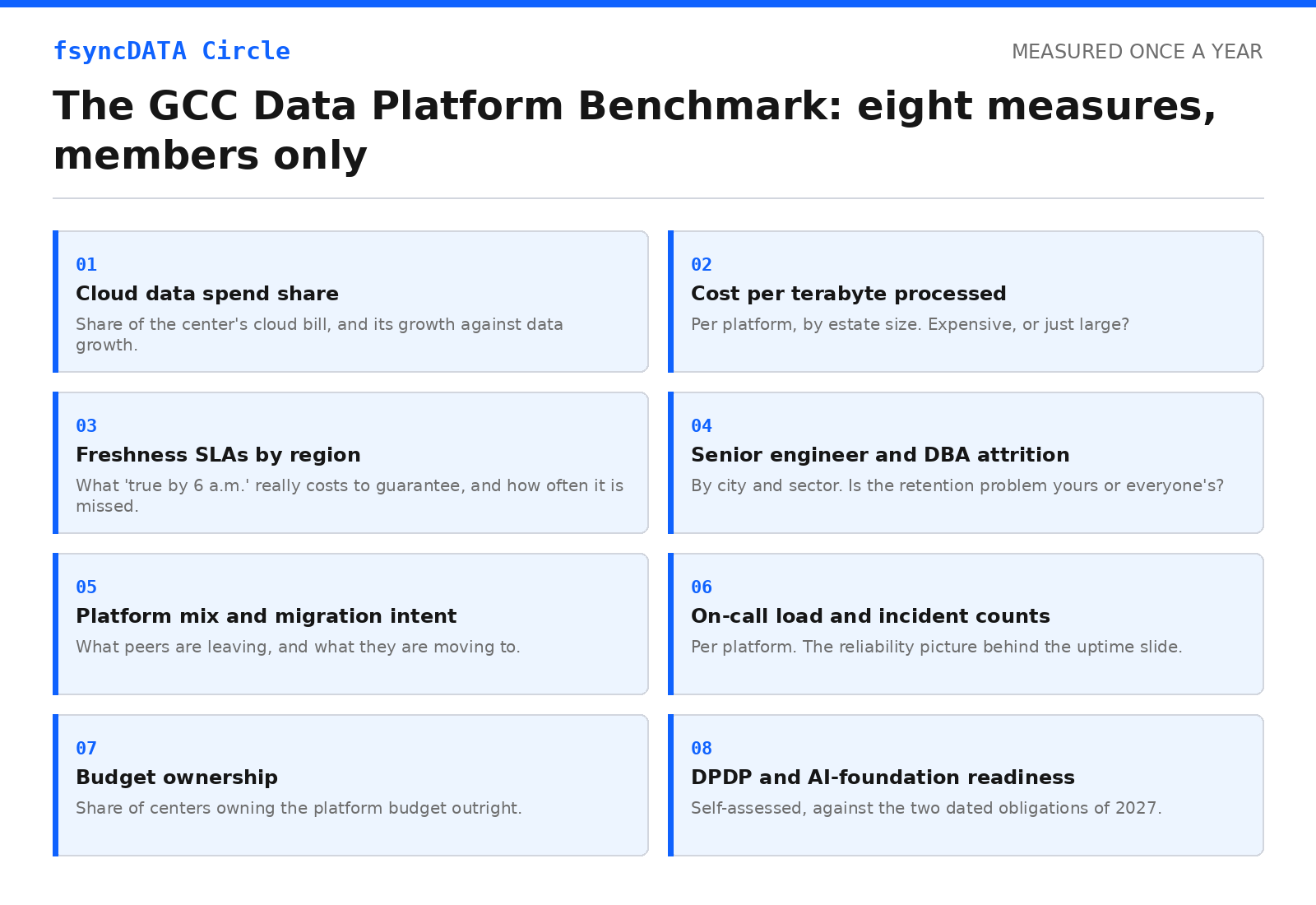
Every one of the GCC data leaders we have spoken to has been asked by a board or a parent, “is that normal?”, and had no honest way to answer. The GCC Data Platform Benchmark exists so that the answer, for India’s centers specifically, is known to the people who need it and to nobody else.
- Cloud data spend as a share of the center’s cloud bill, and its growth against data growth
- Cost per terabyte processed, per platform, by estate size
- Freshness SLAs by region and how often they are missed
- Senior data engineer and DBA attrition, by city and sector
- Platform mix and migration intent for the coming year
- On-call load and incident counts per platform
- Share of centers owning the platform budget outright
- DPDP and AI-foundation readiness, self-assessed
Responses from GCC data leaders are collected by the secretariat, held on India-resident infrastructure, aggregated and anonymised before anyone, including fsyncDATA, sees results. Minimum five responses per cell or the cell is suppressed. Raw responses are deleted after aggregation. The council audits the process annually. Method and measures are on the GCC data platform benchmark page.
Thank you to our sponsors: there are none, and there never will be
Rule 5 of the charter: the Circle takes no sponsorship money and sells no member data, lists or benchmark responses, to anyone, ever. fsyncDATA funds the secretariat, the platform, the venues and the hospitality outright, and receives nothing in return but the right to listen.
Two open doors beside the Circle: the GCC leadership conferences and fsyncDATA Learning
The Circle is invitation-only by design. Beside it, fsyncDATA runs two open-door programmes for everyone who runs, builds or aspires to run India’s capability center data platforms, GCC data leaders and the engineers who will succeed them alike. GCC data leaders who want the private room join the Circle; everyone, GCC data leaders included, is welcome at the open door.
The GCC leadership conferences. Four editions a year, one every three months, alternating between Bengaluru and Hyderabad, one full day each: practitioner tech talks, live break-fix sessions, hands-on labs run by principal engineers, structured networking, and then music, dance and a long dinner. Attendees, speakers, sponsors and exhibitors are all invited; sponsors and exhibitors work the floor, never the stage.
fsyncDATA Learning. Online tracks for aspiring data platform engineers, data platform operations people and data architects, built from the same material the conferences run live, open to working professionals and to colleges. Enrolment opens with the first conference edition.
Nothing said inside the Circle is ever presented at a conference, and no sponsor gains anything inside the Circle. The two are run by different people, and they stay different.
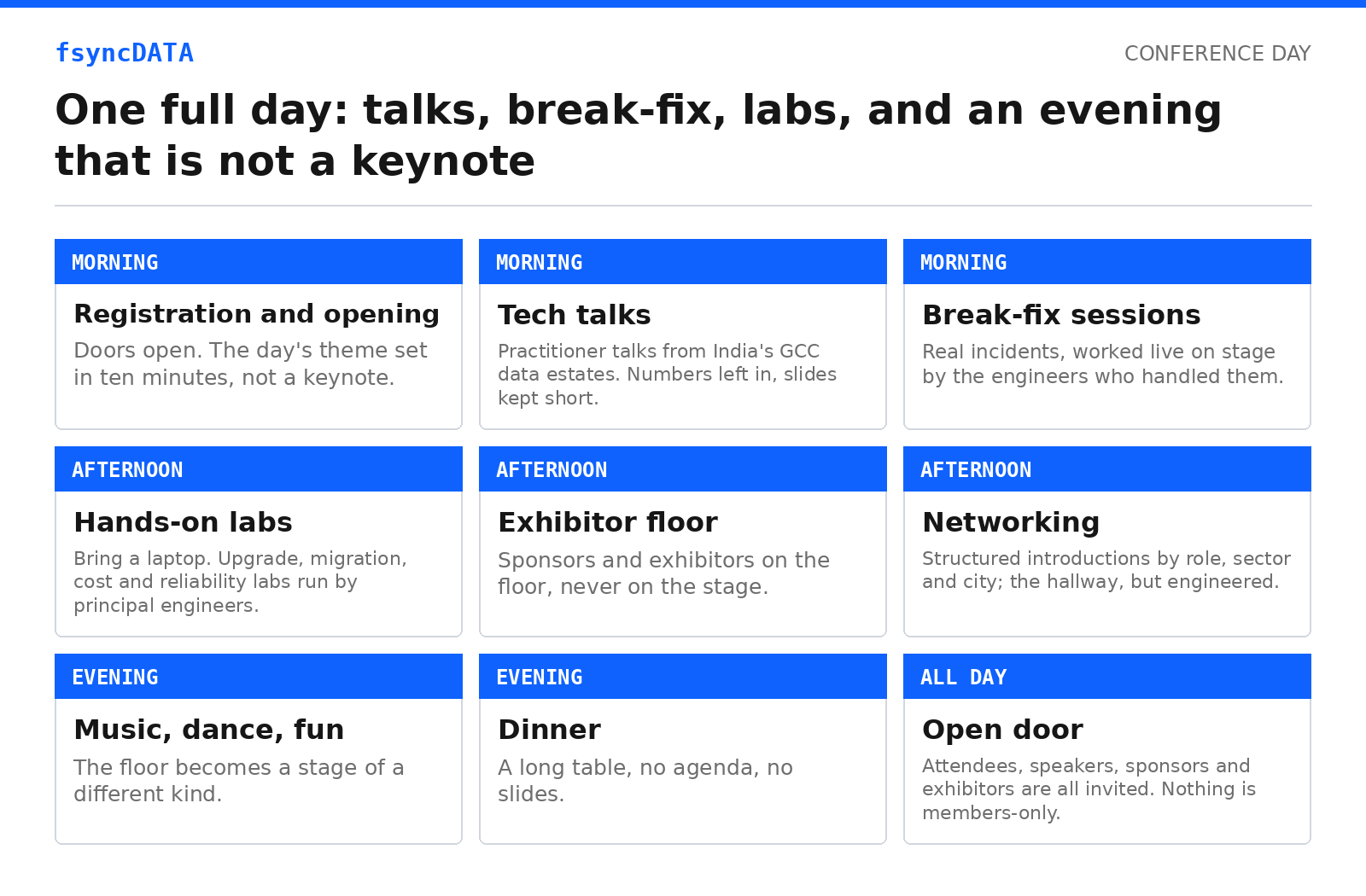
GCC leadership conferences
Every quarter, alternating between Bengaluru and Hyderabad. Tech talks, break-fix, labs, networking, music, dance, dinner. Open door.
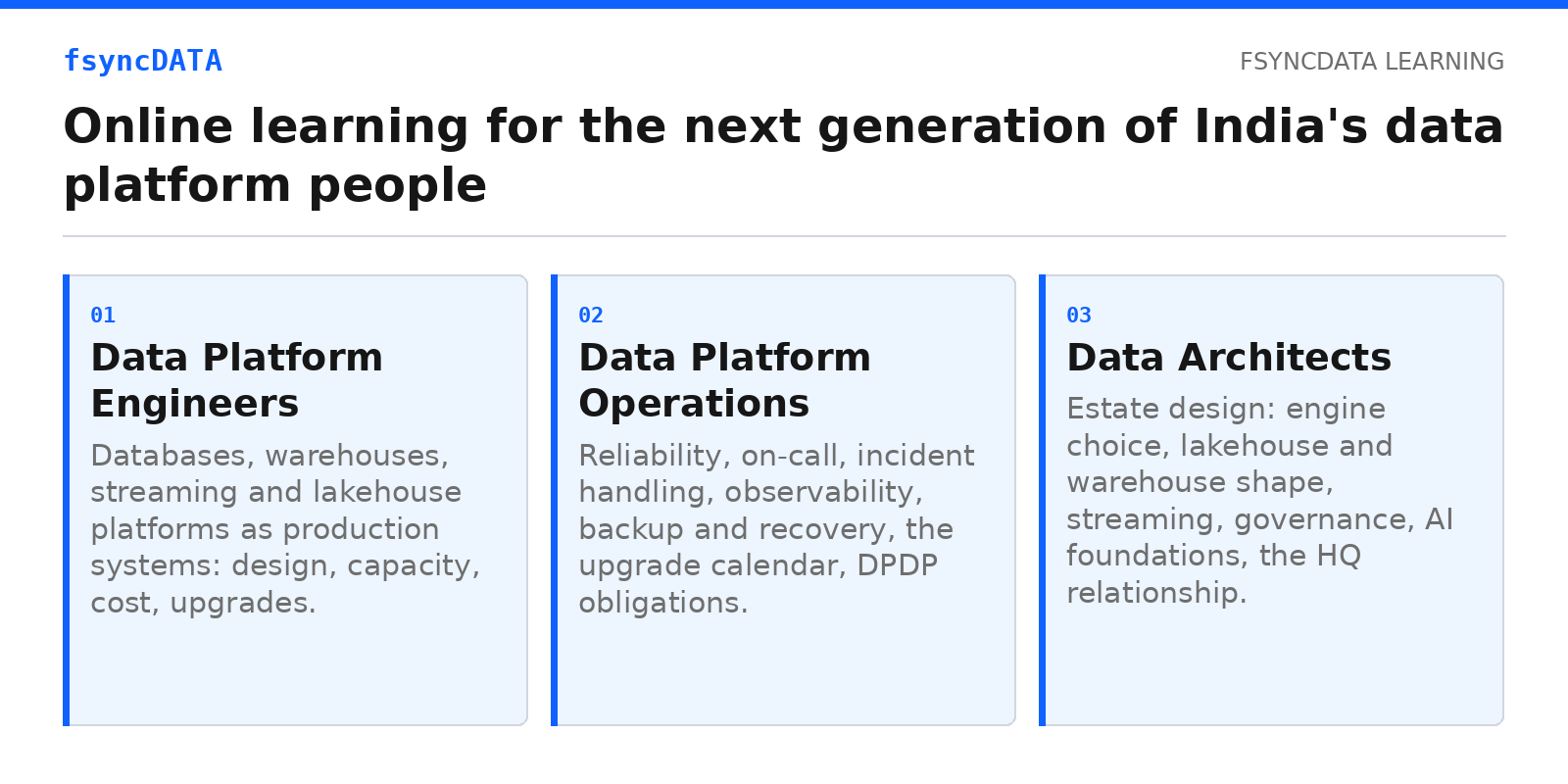
fsyncDATA Learning
Data Platform Engineer, Data Platform Operations, Data Architect. For professionals and colleges.
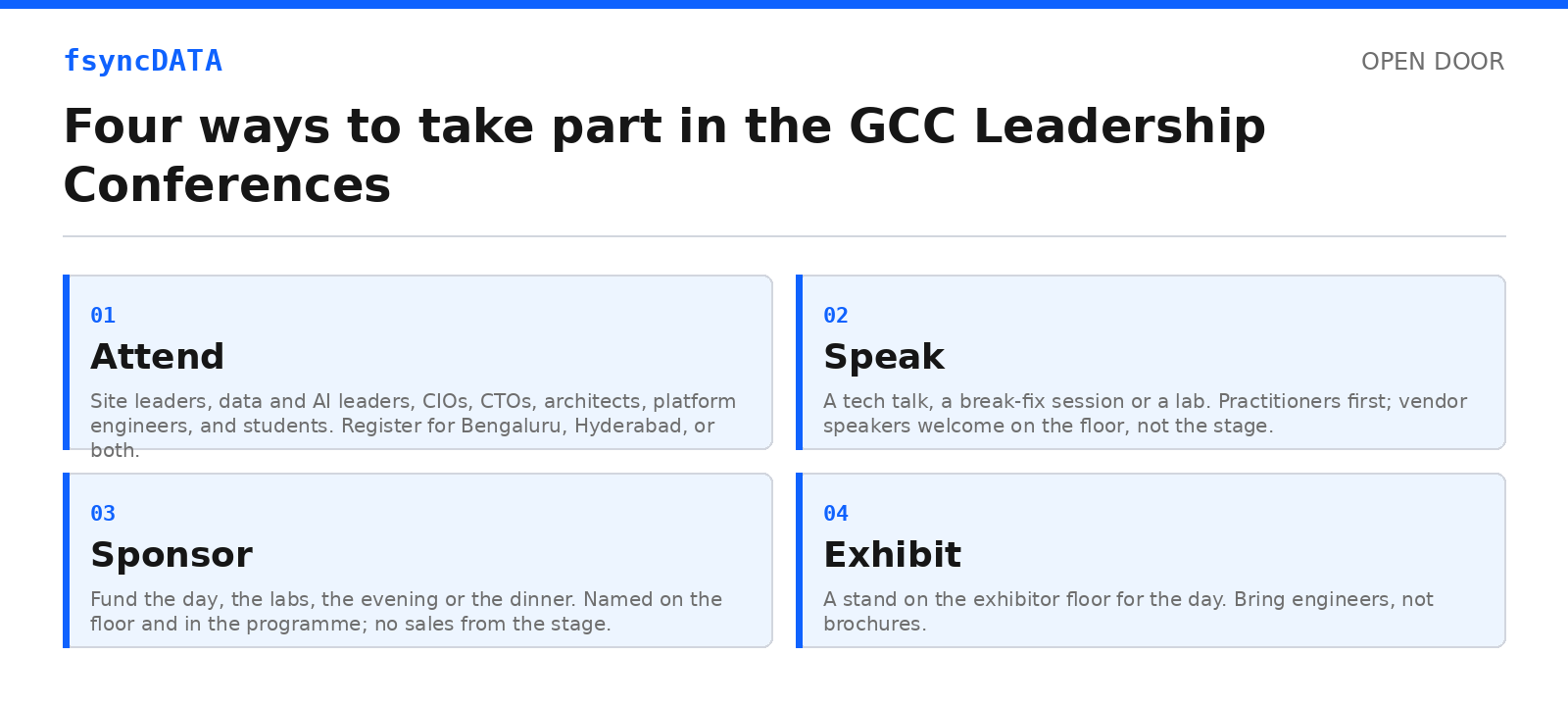
Take part
Attend, speak, sponsor or exhibit. Colleges enrol cohorts. Dates published when confirmed, not before.
Governance: GCC data leaders run it, not us
The members’ council is five GCC data leaders, elected annually by the membership, no two from the same company or role. It owns the charter, approves nominations, hears breaches, audits the benchmark process, sets cohort size, and may dissolve the Circle. fsyncDATA has no seat and no veto.
The secretariat serving GCC data leaders is two fsyncDATA staff, neither in a sales role, contractually bound by the charter. It runs the calendar, the introductions, the reading room, the value ledger and the benchmark collection, and reports to the council on Circle matters, not to fsyncDATA.
The convener is fsyncDATA, a MinervaDB Company, and it is not one of the GCC data leaders in the room. We fund everything, provide principal engineers for office hours, propose the founding cohort, and thereafter hold one nomination vote like any member. We receive the same benchmark report as every member and nothing more. Governance, data handling and the relationship to the MinervaDB Data Leaders Club are described on the members council page.
Membership: personal, earned, never purchased
There is no membership fee for GCC data leaders. The price of a seat is contribution: one session, one benchmark response, or one considered answer a year, and the discipline to keep the charter. fsyncDATA funds the secretariat, the platform and the hospitality outright, and takes nothing back.
Criteria for a seat: you hold one of the leadership roles at a Global Capability Center in India or at its parent’s data organisation; you are accountable for a real production data estate, or you architect or run one day to day; you are willing to bring a real decision to the room, with its numbers, at least once; and you are nominated by a member, or, for the founding cohort, by fsyncDATA, and approved by the council.
What disqualifies: a sales, pre-sales, partnerships or marketing role at any vendor, consultancy or analytics firm, fsyncDATA’s group included; attendance on behalf of a company rather than as yourself; a prior breach of a comparable confidentiality charter.
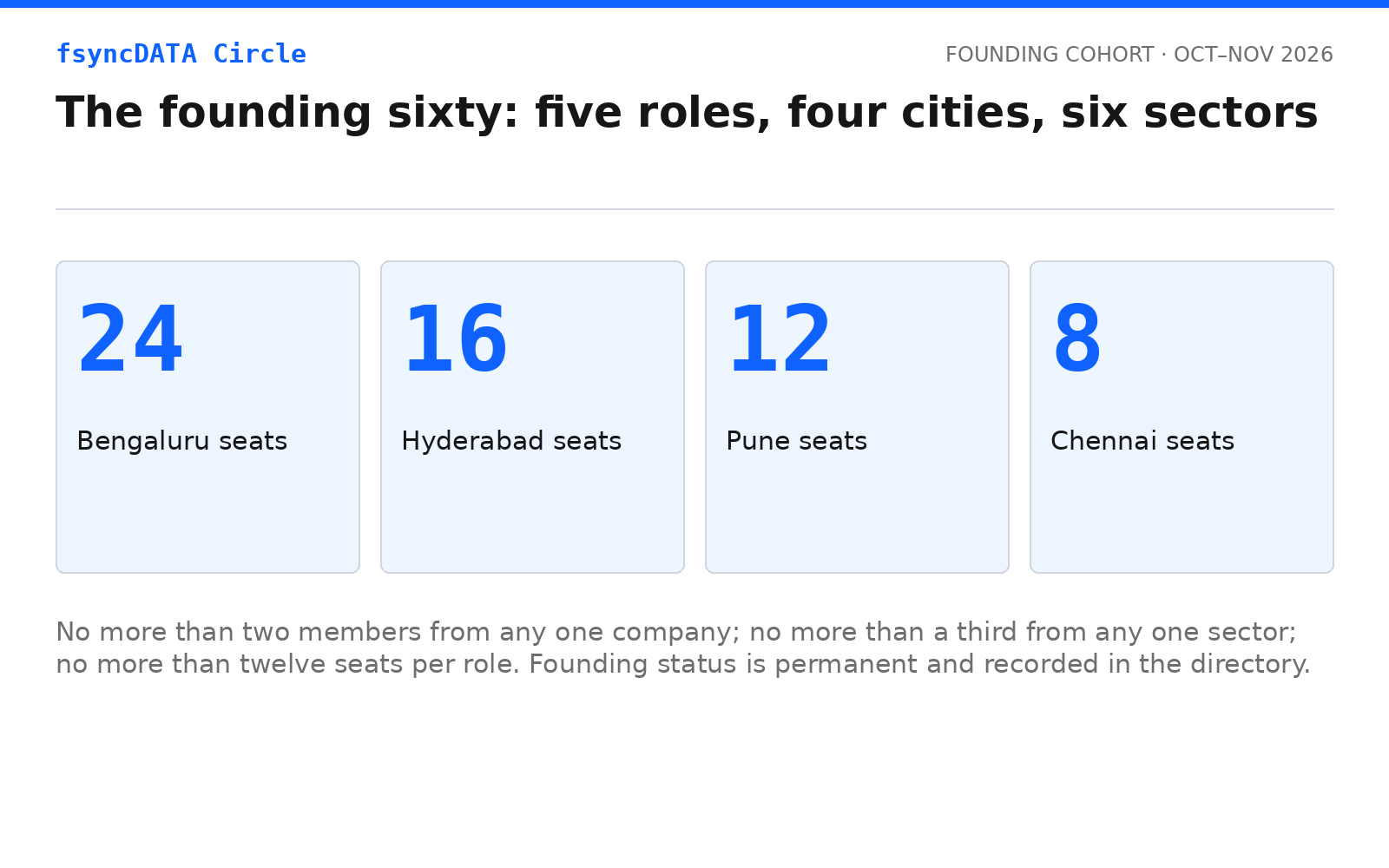
The founding cohort is sixty seats, filled between October and November 2026, across the leadership roles and four cities, with no more than twelve seats per role and no more than two members from any one company. Founding members, all GCC data leaders, adopt the charter, elect the first council, and set the second cohort’s size. Founding status is permanent and is recorded in the directory.
After the founding cohort of GCC data leaders, growth is by nomination only, at a pace the council sets. The Circle is designed to stay small enough that every member can know every other member. If that means it stops growing, it stops growing. Members may leave at any time with no explanation.
Why fsyncDATA convenes a club for GCC data leaders
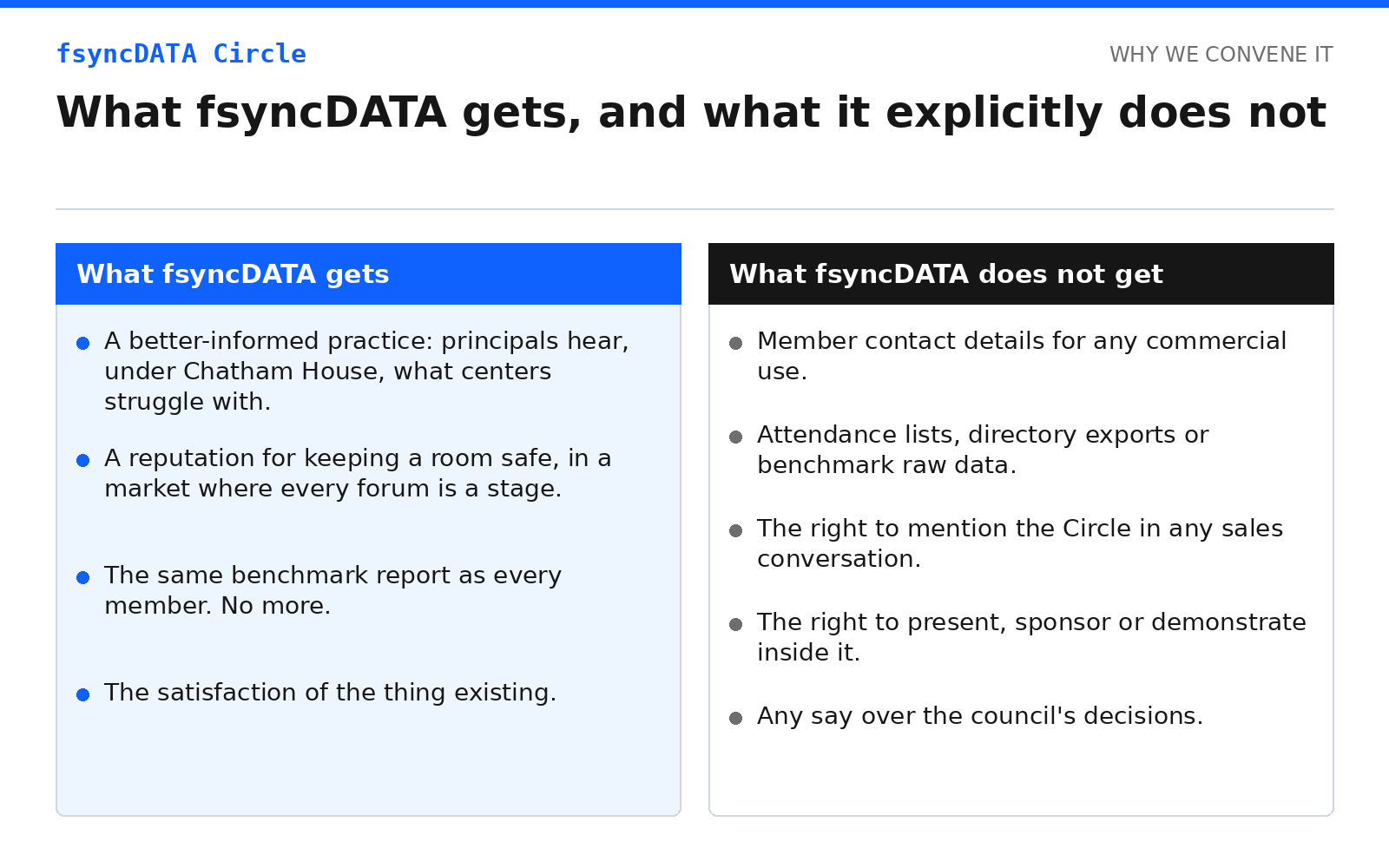
A club convened by a company invites one question first: what is in it for them? The answer should be written down before anyone joins, so that anything beyond it is a breach. What fsyncDATA gets is a better-informed practice, because our principal engineers hear, under Chatham House, what India’s centers actually struggle with. That makes our work better. It does not make you a prospect.
We also get a reputation for keeping a room safe, in a market where every forum is a stage; the same benchmark report as every member; and the satisfaction of the thing existing. What we explicitly do not get: member contact details for any commercial use, attendance lists, directory exports, benchmark raw data, the right to mention the Circle in any sales conversation, or any say over the council’s decisions.
The rooms I learned most in were the ones where nobody was selling. I want to convene one, and I want the rules to stop me if I forget why.
Shiv Iyer, Founder, MinervaDB
For the record: fsyncDATA is the India-domiciled data-platform operations business of MinervaDB Inc., serving Global Capability Centers. That sentence is the only description of our business on this site, so that GCC data leaders know who is holding the door. MinervaDB is described at minervadb.com; nothing on this site is an offer of services.
The test we accept: if any member ever receives a services approach from fsyncDATA, MinervaDB or ChistaDATA that references the Circle, a session, or something learned in one, the member reports it to the council, the council publishes the breach to all members, and the council may dissolve the Circle. A rule you cannot lose by is not a rule.
Accept, ask, or nominate someone better
Three ways for GCC data leaders to answer. Accept, ask, or nominate someone better. Founding invitees may attend the November founding session as guests before accepting. If you believe a colleague belongs in the room more than you do, nominate them; the council treats that as the highest recommendation a seat can receive.
Convince yourself
Why you should accept
Questions before you reply
What happens next for GCC data leaders who accept: you reply; a thirty-minute profile call is scheduled; three introductions are made in your first month; you attend the founding session in Bengaluru in November 2026, in person or online. Every message to the secretariat is answered by a person within two working days.
In one paragraph. The fsyncDATA Circle is an invitation-only club for the GCC data leaders who run India’s Global Capability Center data estates. Sixty founding seats across the leadership roles and four cities. Monthly working sessions with the numbers left in, quarterly deep dives, principal office hours, a 48-hour peer network, a members-only benchmark, and dinners with no agenda. No fee, no sponsors, no sales, including from the company that convenes it. Chatham House, one strike. Governed by an elected members’ council that fsyncDATA does not sit on.
Market context, for GCC data leaders who want the numbers: India hosts about 2,117 Global Capability Centers across 3,728 units, employing roughly 2.36 million people and generating US$98.4 billion in FY26, according to the Nasscom–Zinnov India GCC Landscape 2026. More than half of the Forbes Global 2000 run one. Around 1,200 centers carry embedded AI and ML mandates, all of them on data platforms. That is the estate this room exists to run better.
This site describes the Circle as proposed to its founding cohort, who may amend the charter at the founding session. Nothing on it is an offer of services. GCC data leaders who want to talk to fsyncDATA about their estate should do so outside the Circle, and the Circle will never be mentioned in that conversation.